What causes nearsightedness and farsightedness
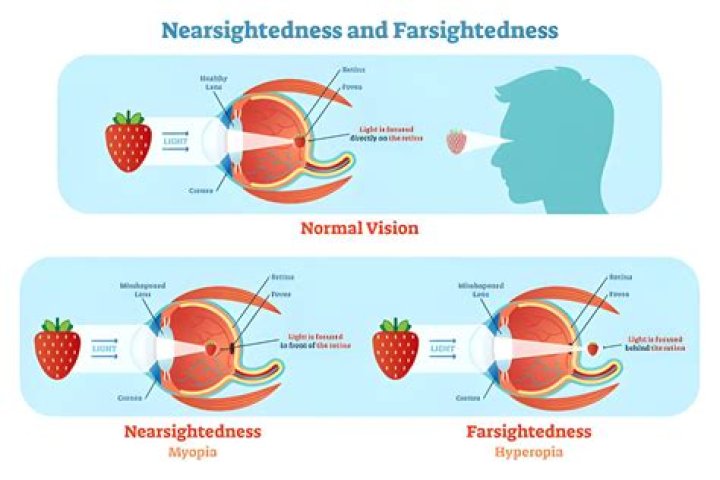
Curvature of the lens – If the lens is too steeply curved in relation to the length of the eye and the curvature of the cornea, this causes nearsightedness. If the lens is too flat, the result is farsightedness.
What is the main cause of nearsightedness?
Nearsightedness, or myopia, occurs when an eyeball grows too long or the cornea becomes too steeply curved. The result is that light entering the eye doesn’t come to a clear focus point on the retina, which is required for clear vision at all distances.
What does it mean when your nearsighted and farsighted?
In short, nearsightedness means the ability to see things nearby with relative clarity, while farsightedness is the ability to only clearly see objects that are far away.
What causes nearsightedness and farsightedness psychology?
Commonly known as nearsightedness, myopia is the opposite of hyperopia. It is a condition in which an image of a distant object becomes focused in front the retina. This happens either because the eyeball axis is too long, or because the refractive power of the eye is too strong.How can I fix nearsightedness naturally?
- Increase the Time You Spend Outside. Spending more time outdoors during adolescence and your early adult years may decrease the lifetime risk of nearsightedness. …
- Protect Your Eyes from the Sun. …
- Eat Healthily. …
- Reduce Eyestrain. …
- Don’t Smoke.
Can a farsighted person become nearsighted?
It’s unusual, but a person can indeed be nearsighted in one eye and farsighted in the other. There are two medical terms used to describe this condition: anisometropia and antimetropia. Anisometropia is the condition where the two eyes have significantly different refractive (light-bending) powers.
How do I stop nearsightedness getting worse?
- Take breaks when using computers or cell phones. …
- Vision therapy. …
- Talk to your doctor on how to prevent myopia.
Does Lasik fix nearsightedness?
A nearsighted eye will focus near objects by itself without reading glasses. LASIK surgery removes this near focus because the nearsightedness has been corrected. This means that as you get older you will need to use reading glasses.How do you fix nearsightedness?
- Laser-assisted in situ keratomileusis (LASIK). …
- Laser-assisted subepithelial keratectomy (LASEK). …
- Photorefractive keratectomy (PRK).
Although most refractive surgical procedures are used to treat nearsightedness, they can also be used for mild to moderate farsightedness. These surgical treatments correct farsightedness by reshaping the curvature of your cornea. Refractive surgery methods include: Laser-assisted in situ keratomileusis (LASIK).
Article first time published onWhy can I suddenly see better without my glasses?
If you think that you are reading better lately without your glasses on, see your optometrist or ophthalmologist. If your near vision is suddenly better than ever, chances are that your distance vision may be worse. Sometimes, when second sight occurs, what is really going on is that you are becoming a bit nearsighted.
Should I wear my glasses all the time if I'm farsighted?
If you are farsighted, you may only need to wear glasses for reading or working on the computer. Depending on your age and the amount of farsightedness, you may have to wear them all of the time.
Can phones cause nearsightedness?
When our eyes spend more time focusing on near objects, like phones, screens or even paperbacks, it makes our eyeballs elongate, which prevents the eye from bending light the way it should. This elongation increases nearsightedness, called myopia, which causes distant objects to appear blurred.
At what age myopia stops?
At the age of 20, myopia usually levels off. It’s also possible for adults to be diagnosed with myopia.
Can nearsightedness be cured?
While myopia cannot be cured, it can be treated to slow or even stop it from getting worse. Because myopia typically presents and develops in childhood, these treatments are targeted to children, typically between 6 and 15 years old.
Does reading cause myopia?
Individuals who spend considerable time reading, working at a computer, or doing other intense close visual work may be more likely to develop myopia.
Are contacts better than glasses?
There is no right or wrong answer to – are glasses or contacts better for your eyes. … Many people have a different prescription for their right eye than their left eye. If this applies, you also need to consistently store each lens in the correct case and apply them to the correct eye.
How do I stabilize myopia?
Eyeglasses or contact lenses are the most common methods of correcting myopia symptoms. They work by refocusing light rays on the retina, compensating for the shape of your eye. Eyeglasses can also help protect your eyes from harmful ultraviolet (UV) light rays.
Is it better to be nearsighted or farsighted?
Lenses with a negative or minus power will extend the focus further back and give a myopic person their best vision. A person who is far-sighted has an easier time seeing far away than up close. This results in either better vision far away or sometimes just less strain to see far away.
Does farsightedness worse with age?
Farsightedness does not get better with age, but it may stop. Once age-related farsightedness begins, it is progressive and will continue over your lifetime. “In fact, farsightedness is present at birth, but the eye naturally corrects itself as it grows,” Liu says.
Is being farsighted rare?
Farsightedness affects about 5% to 10% of Americans. Most children are farsighted but often outgrow the condition. Farsightedness becomes more common with age. At least half of people older than 65 have some degree of farsightedness.
Can you go blind from LASIK?
LASIK surgery itself does not cause blindness, and most cases of LASIK complications are avoidable by following aftercare procedures set forth by your surgeon. If you notice anything out of the ordinary or anything alarming after your LASIK surgery, contact an ophthalmologist immediately.
Can I get LASIK if I'm farsighted?
LASIK surgery— LASIK surgery can correct farsightedness. This treatment can be used to improve near vision in your nondominant eye. According to a 2020 study published in the Journal of Refractive Surgery, LASIK is considered safe and effective for correcting age-related farsightedness.
Can you fix near and farsightedness?
Yes. LASIK surgery can correct nearsightedness, farsightedness, and astigmatism.
Do eyes get worse with age?
Just as your body ages, so too will your eyesight begin to change as you grow older. Some changes are driven by heredity, others are exacerbated by the dry, sunny Southern California weather. All are made worse by smoking.
Why do my eyes go out of focus randomly?
The primary causes of blurred vision are refractive errors — nearsightedness, farsightedness and astigmatism — or presbyopia. But blurry vision also can be a symptom of more serious problems, including a potentially sight-threatening eye disease or neurological disorder.
Will your eyesight get worse if you don't wear glasses?
If you’re an adult who needs glasses due to blurred vision, not wearing glasses doesn’t make your eyes worse, but it makes your eyes work harder. Corrective glasses allow your eyes to work less hard which reduces eye strain and all the other unpleasant effects of not wearing your glasses (when you need them).
What are the side effects of wearing glasses?
Unfortunately, wearing glasses comes with a slight adjustment period. Most people will experience headaches and sore or tired eyes during the first few days. However, as your eye muscles get used to relaxing instead of working so hard to make sense of what you are seeing, the headaches and soreness will disappear.
What type of glasses should a farsighted person wear?
When selecting eyeglasses for the correction of farsightedness, choose aspheric high-index lenses — especially for stronger prescriptions. These lenses are thinner, lighter, and have a slimmer, more attractive profile. Aspheric lenses also reduce the magnified “bug-eye” appearance eyeglasses for hyperopia often cause.
When do you wear glasses for nearsightedness?
Depending on the degree of your myopia, you may need to wear your glasses or contact lenses all the time or only when you need very clear distance vision, like when driving, seeing a chalkboard or watching a movie.
Can I read with distance glasses?
Reading glasses work best for distances less than 18 inches. Since the optimal distance for computer screens is 20 to 26 inches, normal reading glasses may not be the best for regular computer use.